The formal establishment of CSWE in 1952 reflects a complex history that involves varied approaches to the preparation of social workers and the journey of U.S. social work from a vocation practiced by charities to a profession. The following sections give a brief history of CSWE, including events leading up to its founding and some of the important issues faced over the more than 70 years of its existence.
The Road to 1952: AASSW and NASSA
Social work education in the United States began to take shape in 1898 with the founding of the Summer School of Philanthropy by the Charity Organization Society of New York. Similar training programs soon followed in major cities including Boston, Chicago, St. Louis, and Philadelphia, reflecting a growing need for professionalized social work.
By 1919, these efforts coalesced into the Association of Training Schools for Professional Social Workers—later renamed the American Association of Schools of Social Work (AASSW). In 1932, AASSW established formal accreditation procedures, building on earlier, more specialized accreditation efforts led by organizations such as the American Association of Medical Social Workers and the American Association of Psychiatric Social Workers.
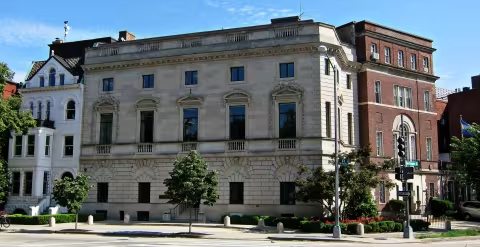
Above, CSWE's first location in Washington, D.C. The building, located at 1744 R St, NW, is now the headquarters of the German Marshall Fund. Photo credit: Wikimedia Commons.
Tensions emerged in 1937 when AASSW restricted its membership to graduate programs. In response, state-supported institutions formed the National Association of Schools of Social Administration (NASSA), advocating for a broader, more generalist approach to social work education to address workforce shortages. The coexistence of these competing systems created confusion and division across the field, ultimately leading to the removal of accreditation authority from both organizations.
Recognizing the need for a unified approach, AASSW, NASSA, and other stakeholders came together in 1946 to form the National Council on Social Work Education. This body conducted a comprehensive review of the field and issued the landmark report Social Work Education in the United States. Its central recommendation: establish a single organization to unify the profession and oversee accreditation standards.
That recommendation led to the dissolution of AASSW and NASSA—and the founding of the Council on Social Work Education (CSWE) in January 1952. CSWE was created “to promote the development of sound programs of social work education” across the United States, its territories, and Canada—establishing a unified, forward-looking framework for the profession.
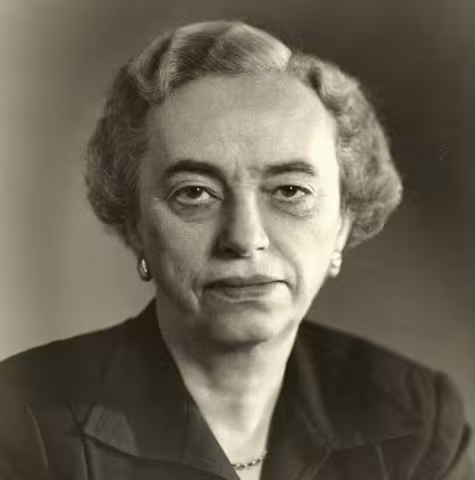
Above: Helen R. Wright, CSWE's first president. Photo credit: University of Chicago Library, Special Collections Research Center.
Helen R. Wright, dean of the University of Chicago’s School of Social Service Administration, became CSWE’s first president, and Katherine A. Kendall, who had worked for the Children’s Bureau, the United Nations, and AASSW, was appointed CSWE’s executive secretary. The association was originally based in New York City, moving to Washington, DC, in 1984 and to Alexandria, VA, in 1990.
Early Accreditation
In the beginning, CSWE accredited only master’s programs in social work, because a perception existed—although it was not universally supported—that preparation for professional social work practice was the province of master's programs. CSWE also accredited Canadian master’s of social work programs until the Canadian Association of Schools of Social Work (now known as the Canadian Association for Social Work Education) took over accreditation of those programs in 1970. However, CSWE continued to accredit Canadian MSW programs on request until 1983.
In October 1961, the CSWE board adopted Social Welfare Content in Undergraduate Education as an aid to higher education institutions that wished to develop such programs. In 1973, CSWE issued accreditation standards covering content in the social work curriculum, staffing, and organization of social welfare programs at the undergraduate level, and in 1974, the National Commission on Accrediting formally authorized CSWE to accredit baccalaureate social work programs. It issued a revised curriculum policy statement in 1982 that included curriculum policy for BSW programs.
The Concerns of the Profession
CSWE's early activities included the formulation and regular review of accrediting standards, recruitment of social work students at the graduate level in response to a decline in enrollment, a study of the social work curriculum, compilation and publication of statistics on social work education programs, and work on federal legislation that pertained to social welfare and social work education.
CSWE's first Annual Program Meeting (now Annual Conference) was held in St. Louis in January 1953 with 400 attendees, and it published the first issue of the Journal of Education for Social Work (now known as the Journal of Social Work Education) in 1965 with Margaret Williamson as editor-in-chief.
Ensuring that the multifaceted social work profession was fully reflected in CSWE's work also was a priority. CSWE was the first among national accrediting bodies to have an affirmative action standard. An affirmative action accreditation standard for women was instituted some years later.
Carl Anderson Scott joined the CSWE staff in September 1968 to assist schools of social work in recruiting students and faculty members from diverse populations as well as attend to minority representation on CSWE governance entities. He later was instrumental in the development of CSWE's Minority Fellowship Program, which seeks to increase the number of scholars, educators, and leaders dedicated to improving services to underserved individuals.
CSWE issued task force reports in 1973 concerning social work education issues for African Americans, Asian Americans, Chicanos, Native Americans, and Puerto Ricans.
A task force on women was created in 1972 that evolved into a commission focused on developing resources on women's issues within social work education. The first meeting of CSWE's Gay and Lesbian Task Force was held in December 1980 and focused on undergraduate, graduate, and continuing education content on gay and lesbian issues as well as gay and lesbian field settings (CSWE, 1981). The task force developed into the Council on Sexual Orientation and Gender Identity and Expression.
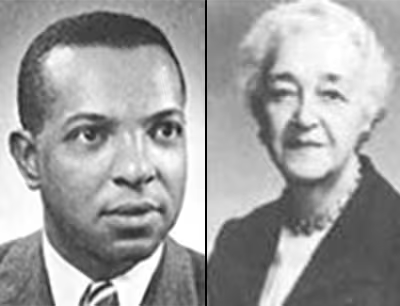
Above from left, Carl Anderson Scott and Margaret Williamson. Photo credit: CSWE archives.
In 2006 the CSWE board of directors approved the establishment of the Center for Diversity and Social & Economic Justice that promotes initiatives to advance social justice and individual and community well-being. CSWE subsequently teamed up with Lambda Legal in 2008-2009 to study social work content related to lesbian, gay, bisexual, and transgender individuals, seeking to determine the resources needed to better serve this population—particularly youth in out-of-home care.
In addition, reflecting international perspectives in social work in U.S. programs and promoting connections with colleagues in other countries have been important to CSWE. It spearheaded projects in schools of social work in Africa and India that fostered student exchange, consulted with entities such as the United Nations and the Pan-American Health Organization, organized the first seminar for schools of social work in Central America in 1962, and participated in conferences of the International Association of Schools of Social Work.
CSWE founded the Katherine A. Kendall Institute for International Social Work Education in 2004 to advance its work in fostering a global perspective in social work education and promoting interactions with international scholars and practitioners. CSWE's International Social Work Degree Recognition and Evaluation Service continues to evaluate social work credentials from outside the United States.
CSWE activities also have focused on specific fields within social work. In 1960 CSWE consultant Eileen Younghusband produced a study on corrections. Mental health was an early locus for CSWE efforts such as the Minority Fellowship Program and projects funded by the National Institute of Mental Health that provided consultation services and produced curriculum materials on chronic mental illness, psychopharmacology, and prevention.
Partnerships
From its inception, CSWE has worked with a wide variety of social work organizations, federal government agencies, nongovernmental bodies, and other entities that have sought to improve social work education.
Initially, an agreement between the National Association of Social Workers (NASW) and CSWE placed NASW representatives on CSWE's governance entities and involved regular dues payments to CSWE. Although NASW elected to sever its formal relationship with CSWE in 1971, its ties to CSWE were strong enough for CSWE to seriously consider a move to NASW's new building in Washington, DC, in 1990 (Beless, 1989). CSWE and NASW continue to work together on issues of mutual interest such as reducing the burden of educational debt on those who earn social work degrees.
In the years since the founding of CSWE, a number of associations focused on social work education have emerged. The National Association of Deans and Directors of Schools of Social Work (NADD) as well as the Group for the Advancement of Doctoral Education in Social Work have made important contributions to CSWE initiatives.
The Association of Baccalaureate Social Work Program Directors (BPD) was established in 1975 to provide a more intense focus on baccalaureate-level social work education that its founders felt was insufficiently addressed by CSWE (Stuart, Leighninger, & Donahoe, 1993). NADD and BPD now have staff members located in the CSWE office and partner with CSWE on social work initiatives. BPD also works with CSWE to produce its scholarly Journal of Baccalaureate Social Work.
Past Presidents
- Helen R. Wright, 1952-1954
- Fedele F. Fauri, 1954-1956
- Jane M. Hoey, 1956-1958
- Grace L. Coyle, 1958-1960
- Ruth E. Smalley, 1960-1963
- Roger Cumming, 1963-1966
- Herman D. Stein, 1966-1969
- Alton A Linford, 1969-1972
- James R. Dumpson, 1972-1978
- Dorothy Bird Daly, 1978-1981
- Richard A. English, 1981-1984
- Bradford W. Sheafor, 1984-1986
- M.C. “Terry” Hokenstad, 1986-1989
- Julia M. Norlin, 1989-1992
- Michael L. Frumpkin, 1992-1995
- Moses Newsome, Jr., 1995-1998
- Barbara W. White, 1998-2001
- Frank R. Baskind, 2001-2004
- Kay S. Hoffman, 2004-2007
- Ira C. Colby, 2007-2010
- Julia M. Watkins, 2010-2012 (beginning of the combination role of Executive Director and President)
- Darla Spence Coffey, 2012-2022
- Halaevalu F.O. Vakalahi, 2022-present