The mission of higher education is discovery, creation, and dissemination of knowledge. It is the space where critical thinking is nurtured and encouraged, where talents are developed, and where the workforce of the future is cultivated. Social work education is an integral part of higher education’s mission, the workforce pipeline, and the global socio-cultural-political economy.
Together, we can advocate for policies and regulations that protect the mission of higher education and publicly demonstrate the commitment of social workers and social work educators to the health and well-being of individuals, families, and communities.
Our Advocacy Priorities
CSWE is committed to ensuring integrity is maintained in higher education, particularly as it relates to social work education. This is done in part through the development of thoughtful policy governing accreditation and by monitoring policies and legislation.
In 2025 and 2026, CSWE led the charge in pushing back against the Department of Education's revised definition of "professional degrees," which did not include graduate-level social work degrees. Learn more here.
Download our RISE rule resource for students here.
CSWE advocates on behalf of the Public Service Loan Forgiveness (PSLF) program. PSLF was created in 2007 to encourage students to pursue public service careers. Eligible employees who work at qualifying public service organizations and make 120 on-time monthly payments—which total 10 years of payments—can qualify for loan forgiveness. For professions such as social work, in which wages often are lower compared to other professions, PSLF encourages professionals to pursue opportunities in critical high-need areas.
Social justice is central to the role social workers play in the various communities in which they serve. Social workers advance social justice by helping individuals address their unique needs and challenges by connecting them with necessary resources to help them lead full, healthy, and productive lives.
Social workers are vital to health care in the U.S., and the need for more social workers in healthcare is growing. Social workers make up the largest percentage of the country’s behavioral health workforce. They provide services in a variety of community settings including schools, clinics, hospitals, child welfare agencies, and local, state, and federal agencies.
As one of the largest providers of professional substance use and mental health services in the United States, social workers are in a unique position to serve the millions of Americans battling addiction. If not directly providing substance and mental health treatment, social workers ensure that individuals, families, and communities are linked with these services, and furthermore, address critical gaps in the continuum of care. This is necessary to ensure adequate recovery and minimize relapse among individuals with opioid use disorder (OUD), as well as other substance use and coexisting disorders. In addition, social workers are prepared to address social factors that impact treatment and recovery, such as housing, education, and job security. These needs are often missed in settings that do not involve social work.
Federal funding supports schools and programs of social work by providing student financial aid programs, health professions education programs, mental and behavioral health training efforts, and social and behavioral research initiatives. These federal efforts promote a sustainable, skilled, and culturally competent workforce that keeps pace with the increasing demand for social work services. CSWE communicates with congressional social work champions throughout the annual appropriations process to advocate for robust funding for programs of importance to social work students and schools. Examples include the Pell Grant program, Public Service Loan Forgiveness, Behavioral Health Workforce Education and Training, Scholarships for Disadvantaged Students, Minority Fellowship Program, and National Institutes of Health research initiatives.
RISE Rule Guide for Students
The Department of Education has changed the definition of "professional degrees," removing graduate-level social work degrees from its list. Learn more about the potential impacts for students with our RISE Rule 1-pager.
Our Policy and Advocacy Team
Advocacy Resources
CSWE’s Advocacy Resource Hub provides toolkits, templates, media coverage, suggested reading lists, data, and more, collected for social work educators' educational and advocacy efforts.
Our Advocacy Handbook: A Guide For Social Workers
Eager to make your voice heard but don't know where to start? Download CSWE's Advocacy Handbook! Prepared by our government relations team at Lewis-Burke Associates, the Advocacy Handbook explores frequently asked questions about federal advocacy and outreach, provides a primer on U.S. Congress and Congressional Committees, and gives guidance on how to communicate with your elected representatives.
Anti-DEI Restrictions Updates & Tracker
CSWE and our advocacy partners at Lewis-Burke Associates are tracking legislation and other directives restricting diversity, equity, and inclusion (DEI) in higher education.
Since 2023, 28 anti-DEI bills have become law. These bills tend to focus on restricting DEI offices/staff, DEI training, diversity statements, and identity-based hiring practices. The Chronicle of Higher Education has created two resources to track these legislative efforts:
» Response by Public Colleges to Anti-DEI Legislation
There have been new updates in Arkansas, Iowa, Kansas, North Carolina, and Ohio since our last update:
Arkansas: In November 2024, State Sen. Dan Sullivan, a Republican, introduced a bill that would ban affirmative action by state and local agencies, including public colleges. The bill mirrors SB 71, which Sullivan introduced in 2023 but failed to pass. It was signed into law by Gov. Sarah Huckabee Sanders on February 18, 2025 and was slated to take effect on July 11, 2025. » Senate Bill 3
Iowa: In March 2025, the Iowa House education committee introduced a bill that would ban public entities including state agencies, local governments, and community colleges from preferential hiring, funding DEI offices, or employing DEI officers. (The bill extends the restrictions that were placed on the public four-year colleges in 2024 to the community colleges.) The bill also restricts public colleges from requiring diversity training and having students to enroll in courses that include DEI or critical race theory as part of general-education or graduation requirements. Gov. Kim Reynolds, a Republican, signed the bill into law in May 2025. The bill took effect July 1, 2025. » House File 856
In April 2024, State Sen. Jeff Taylor, a Republican, introduced an amendment to an education appropriations bill that would prohibit public universities from establishing, maintaining, or staffing a diversity, equity, and inclusion office. The bill would also bar public colleges from requiring diversity statements and giving preferential treatment to anyone based on such statements. The bill passed the Senate and the House on the same day, and Gov. Kim Reynolds, a Republican, signed the bill into law on May 9, 2024. It went into effect on July 1, 2025. » Senate File 2435
Kansas: In April 2024, a conference committee agreed to remove the contents of an earlier version of House Bill 2105, which was unrelated to DEI, and replace it with the contents of House Bill 2460. That bill would prohibit public colleges from requiring students or employees to submit diversity statements for admission, hiring, or promotion. The House and Senate both approved the bill, and Gov. Laura Kelly allowed it to become law without her signature. It took effect on July 1, 2025. » House Bill 2105
North Carolina: In February 2025, State Rep. Brenden Jones, a Republican, introduced a bill that would prohibit state agencies, including public institutions of higher education, from using diversity, equity, and inclusion in hiring practices, having DEI offices or staff, or offering diversity training. On July 3, 2025, Gov. Josh Stein, a Democrat, vetoed the bill. » House Bill 171
Ohio: In June 2023, Rep. Jay Edwards, a Republican, introduced into Ohio's two-year state-budget plan several elements of Senate Bill 83, which would ban mandatory diversity, equity, and inclusion trainings, block DEI programs, and prohibit the use of diversity statements in the hiring process. All anti-DEI components had been removed from the budget bill once it reached the House, and the budget was signed by the governor July 1, 2025. » House Bill 33
Social Work is a Professional Degree
The U.S. Department of Education has published its draft definition of "professional" degrees, and social work is not included.
CSWE urged the Department to include social work in its definition before, during, and after the new definition was written. We continue to advocate on behalf of social work students.
Students: Here is a helpful one-pager on where things stand.
Outreach Resources
As social work educators and leaders, CSWE encourages members to contact their members of Congress to express their positions on the proposed cuts to higher education student aid. Visit Congress.gov to identify your members of Congress in both the House and the Senate. Below are advocacy templates provided by CSWE that can be sent to your member of congress through email, postal service, or even by reading the letter to a staff member at your representative's office.
Download: Advocacy message template: This advocacy message template is for the proposed cuts to higher education student aid that were recently approved by the U.S. House Education and Workforce Committee.
Download: Minority Fellowship Program (MFP) Alumni Fact Sheet: This one-page document includes highlights and outcomes of CSWE's Minority Fellowship Program Alumni.
Resources for Community Organizing
- National Education Association’s Fundamentals of Organizing Toolkit
- American Association of University Professors’ (AAUP) Government Relations Toolkit
- American Library Association’s (ALA) The Frontline Advocacy Toolkit
- Faculty Organizing Against CPHE’s Immediate Action Toolkit: A resource for faculty opposing the Commission for Public Higher Education (CPHE), a newly proposed accreditation body being advanced in several Republican-led states. Unlike legitimate accreditors, CPHE was developed to serve the political agendas of state governments rather than the academic needs of institutions, faculty, or students
U.S. Government Resources and Links
- White House: Presidential Actions
- White House: Briefings & Statements
- White House: Fact Sheets
- U.S. Senate legislation website
- U.S. House of Representatives website
- Congress.gov: Provides current and past legislative activities for both Congressional bodies
- Congressional Budget Office
- Supreme Court of the United States
- SCOTUSblog: Coverage of Supreme Court actions and decisions
- Justia: Free access to federal and state court decisions, codes, and regulations
Data Resources
Additional Advocacy Resources
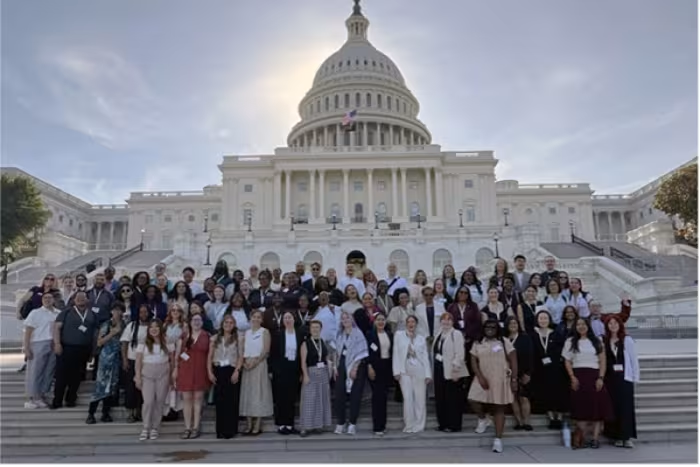
Fellows Forum on the Hill
Policy Updates
Policy Updates From CSWE
Below, catch up news that impacts the social work education community from our team on Capitol Hill.
July 10, 2026: OMB Proposed Revision of Uniform Guidance; CSWE, SSWR Submit Comments
On May 29, 2026, the Office of Management and Budget (OMB) released a proposed revision to the “Regulation for Federal Financial Assistance” (Uniform Guidance). The goal of the revision, according to OMB, is to “improve transparency, accountability, and oversight for how Federal taxpayer dollars are used in the context of Federal grantmaking,” and the Administration hopes to have a final Rule in place by October 1st, 2026. Key provisions of the proposed rule include:
The codification of grant termination capability, multi-year awards, and streamlined Notices of Funding Opportunity;
» Requiring review by political appointees at federal agencies;
» Conference attendance pre-approval;
» Changes to allowable costs, including publications;
» The Codification of DEI restrictions; and
» Expanding event neutrality to private organizations.
CSWE and SSWR Submit Comments on Uniform Guidance Revisions
CSWE and SSWR are deeply concerned that several provisions of the proposed rule would, if finalized, significantly harm the ability of social work educators and researchers to carry out the federally authorized work they have been funded to conduct, which includes but is not limited to, preparing a desperately needed behavioral health and social services workforce, conducting rigorous research on the health and social conditions of vulnerable populations, and partnering with communities to translate evidence into practice.
On July 10, 2026, CSWE and SSWR jointly submitted official comments on the proposed rule.
July 2, 2026: ED Finalizes Institutional Accountability Metrics; HRSA Scholarships for Disadvantaged Students
ED Releases Final Rule on Institutional Accountability Metrics
On July 1, the U.S. Department of Education (ED) released final rules on institutional accountability, following the conclusion of the negotiated rulemaking by the Accountability in Higher Education and Access through Demand-driven Workforce Pell (AHEAD) committee, the second part of the process of implementing policy changes that were included in the One Big Beautiful Act (OBBBA). Ultimately, the final rule largely reflects the language in the proposed rules that were published by ED in April, and the language that reached consensus during the rulemaking session in January.
Under the final rule, the Debt-to-Earnings (D/E) metric and would be replaced with an “earnings premium” test known as the Student Tuition and Transparency System (STATS). This would require that an institution’s programs must pass an earnings premium test that would apply to all programs and would include opportunities to regain eligibility in the future if eligibility is lost. Under STATS, institutions would have to report program-level tuition, fees, and grant/scholarship data to the Department, as well as notify enrolled students with warnings about programs at risk of losing Direct Loan eligibility and notify Pell-eligible students of their remaining lifetime Pell eligibility at each disbursement. Notably, the "earnings premium" test requires that graduates out-earn individuals with only a high school diploma (or a bachelor's degree, for master's programs). Master’s programs failing this test in two of three consecutive award years would lose Title IV direct loan eligibility, with a pathway to regain it.
ED plans for elements of the final rule to go into effect 60 days after publication in the federal register on July 1, 2026. Institutions are still required to submit the STATS data to ED no later than October 1, 2026, and annually thereafter on October 1.
HRSA Releases Solicitation for SDS Program
The Health Resources and Services Administration (HRSA) has opened applications for the Scholarships for Disadvantaged Students (SDS) Program, a federal funding opportunity that supports health professions schools to offer scholarships to students from disadvantaged backgrounds.
Applications for HRSA-26-096 are due July 28, 2026, by 11:59 p.m. ET. HRSA will also host a technical assistance webinar on July 8, 2026, from 2:00–3:30 p.m. ET.
The current notice identifies eligible health professions programs across a broad range of fields, including medicine, dentistry, nursing, behavioral and mental health, public health, allied health, midwifery, and physician assistant studies. Graduate programs in clinical social work are included under behavioral and mental health.
According to the funding notice, HRSA expects to make approximately 80 awards, with an estimated $51,079,900 available in FY 2026. The listed award range is $1 to $650,000, and there is no cost-sharing or matching requirement.
What’s New in This Solicitation
The new solicitation now opens with a broad statement requiring all proposed activities to comply with current federal law, executive orders, and court decisions. It specifically states that federal funds may not be used to:
» support racial preferences or intentional proxies for race
» deny the biological sex binary
» facilitate illegal immigration
» support other initiatives deemed inconsistent with public safety
The solicitation also includes some new language new language around determining which students qualify as “vulnerable.” The solicitation also references the Make America Healthy Again initiative and incorporates guidance from the Department of Justice (DOJ), among other changes.
Apply on Grants.gov
June 24: Court Stay Temporarily Expands Professional Degree Eligibility Under RISE Rule, Excludes Social Work
On June 24, the U.S. District Court for the District of Columbia preliminarily stayed extra-statutory requirements that the U.S. Department of Education (ED) added to its professional degree definition under the RISE final rule. As a result, ED published an interim list of programs it will treat as awarding professional degrees for the duration of the court’s stay. These programs are now eligible for professional-level loan limits ($50,000 annual, $200,000 aggregate). Unfortunately, the social work profession was not included in the interim list of programs and will not qualify for the professional-level loan limits.
The stay is preliminary and remains in effect only pending further proceedings. The federal government retains an immediate right to appeal the stay and could seek to have the appellate court reverse or pause the district court’s order. ED’s announcement states that these interim designations “may change as litigation proceeds” and recommends that institutions consider capping loan disbursements at graduate-level amounts for programs temporarily classified as professional, specifically to protect students if the stay is later reversed or narrowed.
CSWE will continue to monitor the implementation of the final rule and the anticipated litigation that will follow.
June 17, 2026: HHS Releases Funding Opportunities on Behavioral Health; ED Continues With Interagency Agreements
New Safety Through Recovery, Engagement, and Evidence-based Treatment and Support Program
On June 17, Department of Health and Human Services (HHS) Secretary Robert F. Kennedy Jr. announced $96 million in funding at Substance Abuse and Mental Health Services Administration (SAMHSA) for a new Safety Through Recovery, Engagement, and Evidence-based Treatment and Support (STREETS) program as part of the Great American Recovery Initiative. The program will provide up to eight awards of $3 million annually for 4 years to help communities address substance use and mental health disorders, connect individuals to treatment, and support recovery. Eligible applicants are cities, counties, and Indian tribes or tribal organizations, though hospitals, educational institutions, businesses, and other stakeholders may participate through formal partnerships established via memoranda of understanding. The program does not fund harm reduction services such as syringe services programs. Applications are due July 17, 2026.
Request for Information: Chronic Disease of Addiction
HHS is soliciting comments on a request for information (RFI) on the Chronic Disease of Addiction. Much like in the STREETS solicitation, the RFI highlights the Administration’s opposition to using harm reduction practices in its approach to tackling the overdose and addiction crisis. In particular, the RFI requests comments on the following topics:
» Strengthening Agency Collaboration
» Engaging Faith-Based Providers
» Development of Non-Opioid Options
» Integration of Health Records
» Implementing Medications for Opioid Use Disorder
» Ending Support for Harm Reduction
Interested parties are not required to respond to all aspects of the RFI. HHS indicates that stakeholder responses may be reflected in future solicitations or policies. Organizations with successful research programs or policy ideas are encouraged to leave comments ahead of the July 5, 2026, deadline.
CSWE will continue to monitor opportunities relevant to the social work profession and update membership accordingly.
ED Continues with Interagency Agreements; Aiming to Dissolve the Department
On June 16, ED announced four new Interagency Agreements (IAAs) with the Department of Health and Human Services (HHS) and the Department of Justice (DOJ). HHS will partner with ED on special education and rehabilitative services (under one IAA), and DOJ will partner with ED on civil rights enforcement, student privacy protection, and training and advisory services, outlined in three separate IAA’s. A fact sheet on the IAA’s with HHS can be found here, and the fact sheet(s) on the IAA’s with DOJ can be found at the bottom of ED’s press release found here.
While the Administration continues to move functions outside of ED through administrative actions, the Department cannot be eliminated without congressional approval. Because the Department of Education was established by statute, formally abolishing the agency or transferring many of its statutory responsibilities would require legislation passed by Congress and signed into law. In the meantime, Congress continues to exercise oversight of these agreements, with lawmakers from both parties raising questions about implementation, continuity of services, and whether the transfers are consistent with existing statutory authorities.
June 8, 2026: House Releases FY 2027 Appropriations; Secretary McMahon Faces Questions
On June 8, the House Appropriations Committee released its full report for the FY 2027 Labor-HHS-Education bill. For programs within the Department of Education (ED), the bill proposes to increase the maximum Pell Grant award to $7,445 for the 2027-2028 award year. It would fund the Federal Work Study (FWS) program at $908 million, a decrease of approximately $322 million from the enacted FY 2026 level but is significantly more than the $123 million that was proposed in President Trump’s FY 2027 Budget Request (PBR). The National Institutes of Health (NIH) would be funded at $47.3 billion, an increase of $100 million or 0.2% over FY 2026 enacted levels.
The Health Resources and Services Administration (HRSA) would receive $8.7 billion in discretionary funding, notably more than the $1.9 billion in discretionary funding that was proposed in the PBR. Within HRSA, the bill would provide:
» $159 million for the Behavioral Health Workforce Education and Training (BHWET) programs, a $1 million increase from FY 2026 levels;
» $48.2 million for the Geriatrics programs including the Geriatrics Workforce Enhancement Program and Geriatric Academic Career Awards.
» $40 million for the Substance Use Disorder Treatment and Recovery (STAR) Loan Repayment Program, flat funding with FY 2026 enacted levels; and,
» $55 million for Scholarships for Disadvantaged Students.
The Substance Abuse and Mental Health Services Administration (SAMHSA) would be funded at $7.3 billion in FY 2027, consistent with FY 2026 enacted levels. Within SAMHSA, the bill would level fund the Minority Fellowship Program (MFP) in the amount of $19,516,000.
Secretary McMahon Faces questioning from Congress on the RISE Rule
To justify ED’s proposed FY 2027 budget amongst other policy decisions, Secretary of Education Linda McMahon testified before the House Education and Workforce Committee on May 14. Graduate borrowing caps and the professional degree definition drew the most sustained, bipartisan pushback during the hearing. Representatives from both parties raised concerns about the “professional degree” definition finalized by the Department, including how the new graduate loan caps would push students into the private loan market and worsen healthcare and education workforce shortages. Representatives Bonamici (D-OR), Hayes (D-CT), Norcross (D-CA), and Omar (D-MN) notably highlighted social work as one of the declassified professions widely affected by the final rules. Secretary McMahon defended the rule as final but expressed willingness to discuss workforce pathways for registered nurses and physician assistants.
The Senate Appropriations Committee has not yet released its version of the FY 2027 Labor-HHS-Education bill but is anticipated to do so in the coming weeks. CSWE will continue to monitor developments and negotiations in the Senate as they progress.
April 2026: FY 2027 Appropriations Season Commences
On Friday, April 3, the White House Office of Management and Budget released President Trump’s fiscal year (FY) 2027 budget request. The proposal prioritizes national security investments, while proposing major cuts to federal programs at the U.S. Department of Health and Human Services (HHS) and the U.S. Department of Education (ED) supporting social work education and training.
For programs within ED, the budget request proposes level funding of the maximum Pell Grant award at $7,395 for the 2027-2028 award year. It would fund the Federal Work Study (FWS) program at $123 million, a decrease of approximately $1.1 billion, and notably proposes reforming FWS to require employers to pay 90 percent of student wages.
For agencies within HHS, the request would provide $17.6 billion for a new operating agency called the Administration for a Healthy America (AHA). AHA would consolidate key functions of many health agencies including the Health Resources and Services Administration (HRSA), Substance Abuse and Mental Health Services Administration (SAMHSA), and several programs from the Centers for Disease Control and Prevention (CDC) into the new agency. The budget request would fund SAMHSA at $6.8 billion but notably would eliminate the minority fellowship program (MFP). The budget request would also fund HRSA for a total of $1.9 billion in discretionary funding, including 129.3 million for Behavioral Health Workforce Development Programs, including the Behavioral Health Workforce Education and Training Program (BHWET), Addiction Medicine Fellowship Program, and Substance Use Disorder Treatment and Recovery Loan Repayment Program.
The budget request proposes $41.5 billion for the National Institutes of Health (NIH) and caps NIH indirect cost rates at 15 percent, as well as fully-fund upfront all research project grants in 2027.
The budget request kicks off the annual federal spending process for the fiscal year and provides suggested funding based on the Administration’s priorities, but it is important to note that Congress ultimately determines federal funding amounts.
For CSWE’s official statement on the FY 2027 President’s Budget Request, please see here.
In conjunction with the release of the budget, Congress has begun the process of determining the funding levels of agencies for FY 2027, slated to begin on October 1, 2026. While the deadline to submit appropriations requests to the House and Senate have passed, the House Appropriations Committee has scheduled various mark-ups of funding legislation, with the bill funding programs within HHS and ED to occur on Friday, June 5 and Tuesday, June 9, 2026. Over the next months, Administration officials will also provide testimony on Capitol Hill to key budget and appropriations committees.
ED Releases Final Proposed Rules on Workforce Pell and Institutional Accountability Metrics
On April 20, the U.S. Department of Education (ED) released proposed rules on institutional accountability, following the conclusion of the negotiated rulemaking by the Accountability in Higher Education and Access through Demand-driven Workforce Pell (AHEAD) committee, the second part of the process of implementing policy changes that were included in the One Big Beautiful Act (OBBBA).
Ultimately, the proposed rules largely reflect the language that reached consensus during the rulemaking session in January. Under the proposed final rules, the Debt-to-Earnings (D/E) metric and would be replaced with an “earnings premium” test known as the Student Tuition and Transparency System (STATS). This would require that an institution’s programs must pass an earnings premium test that would apply to all programs and would include opportunities to regain eligibility in the future if eligibility is lost.
Under STATS, institutions would have to report program-level tuition, fees, and grant/scholarship data to the Department, as well as notify enrolled students with warnings about programs at risk of losing Direct Loan eligibility and notify Pell-eligible students of their remaining lifetime Pell eligibility at each disbursement. Notably, the "earnings premium" test requires that graduates out-earn individuals with only a high school diploma (or a bachelor's degree, for master's programs). Master’s programs failing this test in two of three consecutive award years would lose Title IV direct loan eligibility, with a pathway to regain it.
ED welcomes public comments regarding the proposed rules until May 20, 2026, and CSWE is slated to respond on behalf of members.
ED Hosts First Round of the Accreditation, Innovation, and Modernization (AIM) Negotiated Rulemaking Committee
The U.S. Department of Education (ED) commenced another negotiated rulemaking session by the Accreditation, Innovation, and Modernization (AIM) committee, which convened for its first out of two-rulemaking session from April 13–17, 2026, to discuss ED’s proposal to overhaul the federal accreditation framework. The AIM negotiated rulemaking committee is a product of President Trump’s Executive Order (EO) 14279, Reforming Accreditation to Strengthen Higher Education, signed on April 23, 2025. The order directed ED to reform what the administration characterized as a “dysfunctional accreditation system” and ensure colleges focus on delivering quality programs at a reasonable price.
During this first session, negotiators went through the Department’s 151-page initial draft, organized around a few broad focus areas:
» Reducing regulatory burden on accrediting agencies;
» Limiting anti-competitive behavior in the accreditation landscape;
» Mandating institutional compliance with federal and state law, particularly regarding free speech and prohibitions on preferential treatment based on protected characteristics;
» Requiring program-level student outcome data to assess return on investment; and
» Incorporating institutional affordability and credit transferability as factors in accreditor evaluations.
Throughout the rulemaking session, many negotiators, specifically those representing students, institutions, and accreditors, noted several provisions of concern proposed by the Department, including some that they deemed to be executive overreach into areas traditionally governed by institutional autonomy and peer review. Furthermore, some negotiators also expressed concern over provisions in the draft regulations including how student achievement is measured, new credit transferability expectations for institutions, language that directs accreditors to ensure “academic freedom” and “intellectual diversity” are applied consistently to institutional standards, and the ability for ED to override accreditor decisions.
The second and final week of the AIM rulemaking committee is scheduled for May 18–22, 2026, and will include a formal vote on the proposed regulations. If the committee fails to reach consensus, ED is not legally required to incorporate committee recommendations and may proceed to finalize rules on its own terms. Following the second session, ED will publish a Notice of Proposed Rulemaking (NPRM), opening the 30-day public comment period for stakeholder feedback.
February 2026: ED Releases Proposed Rules on Student Loan-Related Policies
On January 30, 2026, the U.S. Department of Education (ED) published proposed rules that were created and agreed upon by the Reimagining and Improving Student Education (RISE) committee. As a reminder, the RISE committee focused on the restructuring of student loans, eliminating Grad PLUS loans for graduate and professional students, establishing new loan limits, and simplifying repayment plans. The committee reached consensus during the rulemaking sessions on all the language proposed and worked through by negotiators and Department. As expected, the proposed rules largely reflect what was agreed upon during the negotiations.
The proposed rules include the new loan caps with the annual graduate loan limits at $20,500 for graduate students and $50,000 for professional students; the aggregate limit is capped at $100,000 for graduate students and $200,000 for professional students. Social work was not considered a professional degree and therefore is subject to the annual graduate loan limits at $20,500 and aggregate limit at $100,000.
In the proposed final rule, ED acknowledged the rulemaking committee’s consideration for social work not being classified as a professional degree. The department provided various rationales for their exclusion, including that “MSW and DSW would not meet the professional degree definition because neither degree is generally required to obtain an entry-level licensure in the social work field or to begin work in a profession.” An additional rationale for social work and additional programs’ exclusion from the professional degree definition was that professional degrees should “require another profession to supervise their practice.”
ED welcomes public comments to the proposed rules until March 2, 2026. CSWE plans to submit a comment advocating for social work education and will continue to advocate to legislators on the importance of social work education and the impact it has on our communities.
January 2026: Senate Appropriations Committee Passes Fiscal Year 2026 Labor, Health and Human Services, Education and Related Agencies Appropriations Act
On Tuesday, January 20, the Senate Appropriations Committee released the Fiscal Year (FY) 2026 Labor, Health and Human Services, Education and Related Agencies Appropriations Act, as part of a broader mini-bus package. For issues pertaining to social work and social work education, the bill would:
Fund $7.5 billion to the Substance and Mental Health Services Administration (SAMHSA), including:
» $1.6 billion for the State Opioid Response Grants
» $1.9 billion for the Substance Use Prevention, Treatment, and Recovery Services Block Grant; and
» $19.5 million to the Minority Fellowship Program (MFP)
Maintain the maximum Pell award at $7,395 for the 2026-2027 school year and provide $1.2 billion for Federal Work Study and $910 million for Federal Supplemental Educational Opportunity Grants.
In the Joint Explanatory Statement, the Senate directs the Department of Education (ED) to provide biweekly briefings to Congress on the implementation of interagency agreements (IAAs) that transfer ED’s functions to various agencies, including functions within the Office of Postsecondary Education (OPE) to the Department of Labor (DOL).
The bill still will still need to pass the Senate and additionally the House, which will then go to President Trump to sign the bill into law. A summary of what is included in the bill as it pertains to health, workforce, and education can be found here. CSWE will continue to monitor the status of this appropriations package and any developments as the bill reaches the Senate and House floor for final votes.
December 2025: CSWE Endorses Introduction of the Loan Equity for Advanced Professionals (LEAP) Act
On December 15, Representatives Tim Kennedy (D-NY), Jill Tokuda (D-HI), and Shomari Figures (D-AL) introduced the Loan Equity for Advanced Professionals (LEAP) Act. The legislation addresses provisions introduced by H.R. 1, which capped federal Direct Unsubsidized Loan limits for graduate students at $20,500 annually and $100,000 in aggregate, while allowing higher limits for professional students.
The LEAP Act would raise graduate student loan limits to match those available to professional programs, ensuring equitable access to federal financial aid for students pursuing advanced degrees in fields such as social work.
CSWE strongly endorses the LEAP Act in support of master’s level social work students and will continue advocating for policies that improve affordability and access to graduate education.
Department of Education Enters Negotiated Rulemaking on Changes in Institutional and Programmatic Accountability Measures: On December 8, the U.S. Department of Education (ED) began its second negotiated rulemaking committee as part of the process for implementing policy changes included in the One Big Beautiful Bill Act (OBBBA). The Accountability in Higher Education and Access through Demand Committee will meet to address the implementation of the new Workforce Pell Grant program, changes in institutional and programmatic accountability measures, including loss of Direct Loan eligibility for certain programs, and Financial Value Transparency and Gainful Employment.
For social workers, institutional and programmatic accountability measures will be of most importance. OBBBA established a “do not harm” standard, which would:
» “Prohibit new federal student loans from paying for undergraduate degree programs where the majority of former students earn less than the median high school graduate in the same state
» Prohibit new federal student loans from paying for graduate programs where the majority of former students earn less than the median bachelor’s degree recipient in the same field in the same state
» Programs lose eligibility if they fail to meet the standard for two years in a three-year period.”
Researchers at the Postsecondary Education & Economics Research Center at American University noted that “fewer than 1 percent of students in [social work] programs, including fewer than one-half of one percent (0.3 percent) of students in master’s degree programs in social work, would fall short of the OBBBA threshold.” Nonetheless, ED still has to finalize the regulations which could determine programs excluded from receiving federal student loans. CSWE will continue to monitor the status of these negotiations. The second session will be scheduled for January 5 through January 9 of 2026.