The Katherine A. Kendall Institute for International Social Work Education (Kendall Institute) strives to prepare educators, researchers, students, and practitioners for an increasingly global community through its programs and initiatives. Established with contributions to an endowment in honor of international social work icon Dr. Katherine A. Kendall, the Kendall Institute promotes standards of excellence for international social work to integrate related concepts into social work curricula and seeks to enrich perspectives, understandings, collaboration, and networking within the social work community.
About Katherine A. Kendall
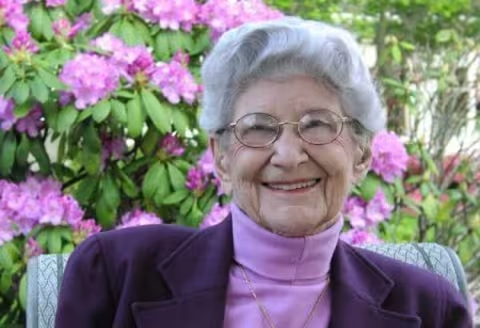
Katherine A. Kendall, a world-renowned icon of social work education, was actively involved in the development of social work education in the United States. In 1950 she became executive secretary of the American Association of Schools of Social Work (AASSW). She was involved in the complex negotiations that merged AASSW and other social work governing bodies into the Council on Social Work Education (CSWE), which is recognized as the sole accrediting body for social work education in the United States. Throughout her career Kendall was able to merge her global outlook with her passion for social work education. In 2004, she founded and endowed the Kendall Institute to promote and enhance the social work profession's international perspective.
Kendall Institute History & Goals
CSWE established the Kendall Institute in 2004 with an endowment from the Katherine A. Kendall Fund. Its overall mission, shaped by the vision of international social work icon Katherine A. Kendall, is to foster the mainstream development of international content in social work education and to increase the cross-organizational collaboration in project development as well as research and data collection and dissemination. Specifically, it promotes the implementation of programs and initiatives within the global social work education community. These programs and initiatives will prepare practitioners and researchers with the appropriate knowledge and requisite skills for practice in an increasingly interdependent global community.
Advisory Board
The programmatic policy-making body for the Kendall Institute is the Advisory Board. Board members are experts from the international social work community and represent the International Association of Schools of Social Work, the Canadian Association for Social Work Education, and other partnerships for international education.
CSWE's staff liaisons for the Advisory Board are Maisaloon Dias and Janie Jackson.
Board Leadership
Chair
Golam Mathbor, MSW, Ph.D.
Monmouth University
Appointment: July 2025 - June 2028
Vice Chair
Itunu Ilesanmi, Ph.D., MSW, MPA
University of Northern Iowa
Appointment: July 2024 - June 2027
CSWE
Halaevalu F. Ofahengaue Vakalahi, PhD, MSW, MEd
President and CEO, CSWE
Organizational Represenatives
Leticia Villarreal Sosa, PhD, LCSW, PEL SSW
University of Texas Rio Grande Valley
Chair, Commission on Global Social Work Education
Antoinette Lombard
Professor in Social Work
University of Pretoria, South Africa
International Association of Schools of Social Work
President
Carole Carpot, Maîtrise, DEA, MSW, RSW
Canadian Association for Social Work Education
Executive Director
CSWE Staff Liaisons
Maisaloon Dias, LSW, MSW, Director of Centers & Initiatives, CSWE
Janie Jackson, Centers & Volunteer Specialist
Board Members
Elaine Congress, MSSW, MA, DSW, LCSW
Fordham University
Appointment: July 2020 - June 2026
Lynne Healy, Ph.D., Legacy Member
University of Connecticut
Appointment: July 2011 - Present
Catherine LaBrenz, LMSW, Ph.D.
The University of Texas at Arlington
Appointment: July 2024 - June 2027
Chathapuram Ramanathan, Ph.D., ACSW, LMFT,CSW
Illinois State University
Appointment: July 2020 - June 2026
Cudore Snell, DSW, LICSW
Howard University
Appointment: July 2020 - June 2026
Andre Stevenson, MSW, MPH, Ph.D.,
TESOL Graduate Certificate
Elizabeth City State University
Appointment: July 2025 - June 2028
Rebecca Thomas, Ph.D.
University of Connecticut
Appointment: July 2022 - June 2028
Initiatives & Projects
Kendall Grant Program Since 2015 the Kendall Institute has awarded grants that support international social work education projects that help prepare United States students for global citizenship and encourage opportunities for international social work. Learn more about the Kendall Grant Program here.
International Social Work Leader Review CSWE's Commission on Global Social Work Education and the Kendall Institute collaborate to offer the International Social Work Leader Review, which highlights an individual in the global social work community. Click here for more information.
The Fulbright Initiative is a collaboration between the Kendall Institute and the Commission on Global Social Work Education. This Initiative seeks to encourage social work educators, students, leaders and scholars to become “Fulbrighters”; promote and support increased Fulbright opportunities for the social work profession; and provide mentorship for future social work applicants by Fulbright Alumni.
For more information please view our informational webinar here. The webinar focuses on global teaching and research opportunities in social work, with primary emphasis on the application process for US-based scholars.
Global and Intercultural Competence is curricular resource to prepare students to practice in an interconnected world developed by the Center for Diversity and Social & Economic Justice. Teaching content that can be brought into existing courses is provided. The resource was developed as part of a collaboration between the Kendall Institute, the Diversity Center and Words Without Borders. View the resource here.
Grant Program
Since 2015, the Katherine A. Kendall Institute for International Social Work Education (Kendall Institute) has awarded grants to support international social work education projects that prepare U.S. students for global citizenship and encourage opportunities for international social work.
The Kendall Institute Grant Program facilitates the development of international social work education materials and curricula by helping educators create tools that bring the global context into U.S. social work classrooms. These projects leverage creativity and innovation with existing knowledge and practice to influence the future of international social work education nationwide.
The Kendall Institute will award up to five $10,000 grants in this cycle. The 2026 grant cycle spans three years, July 1, 2026 - June 30, 2029. The 2026 Grant Cycle will launch on Monday January 12, 2026, and close on Sunday, March 15, 2026 at 11:59 pm.
The 2026 grant cycle application closed on Sunday, March 2026. Stay tuned for the 2027 grant cycle application.
Eligibility
Each year the Kendall Grant is open to all CSWE members, including program members in candidacy. One member of the project team must be a CSWE member throughout the duration of the grant. Projects may include collaboration with community partners or organizations; however, the project lead must be a member of a CSWE member school.
Exclusion Criteria
The Kendall Institute will not consider funding for:
- overhead costs;
- salary or personnel projects for which the primary purpose is travel;
- exclusively research-based projects; or
- projects without tangible, transferable deliverables
Application Process
Applications must be submitted electronically through the Submittable online form, adhering to specifications outlined below. Applicants must complete all sections of the application. Project budget must be included in an Excel document. Submissions received after the deadline or not in compliance with the standards outlined above will not be reviewed for submission. The next cycle will open in January 2027.
If you have questions or concerns regarding the application process, please email kendallinstitute@cswe.org.
Timeline (2026 Grant)
| Request For Proposals released | January 12, 2026 |
| Informational webinar | February 5, 2026 February 11, 2026 |
| Proposals due to CSWE | March 15, 2026 |
| Awardees notified | May 18, 2026 |
| Awardee Orientation | July 2026 |
| Funds disseminated to awardees | July 2026 |
| Implementation of grant project | July 2026 |
| Y1 Cohort Zoom call | October 2026 |
| Y1 Individual grantee meeting with CSWE Staff | February 2027 |
| Y2 Cohort Zoom call | October 2027 |
| Y2 Individual grantee meeting with CSWE Staff | February 2028 |
| Mid-Term Progress report submitted | February 2028 |
| Second installment of grant funds released* | April 2028 *After review of progress report |
| Y3 Cohort Zoom call | October 2028 |
| Y3 Individual grantee meeting with CSWE Staff | February 2029 |
| Final project submitted | June 30, 2029 |
| Presentation to 2025 Cohort and CSWE staff via Zoom | May 2029 |
CSWE Annual Conference *Grantees will have the option to present over Zoom or in person at the CSWE Annual Conference | October 2029 |
Grantees/Projects
2025
The Council on Social Work Education (CSWE) is pleased to announce the grantees for the ninth cycle of the Katherine A. Kendall Institute for International Social Work Education grant program. Grantees were selected based on their innovative projects that demonstrated sustainability, transferability, and potential to advance the field of international social work education.
This year's grantees and projects are as follows:
INSPIRARE Global: The International Network of Social Work Praxis & Innovation for Research, Advancing Scholarship, Rights, and Education
Project Lead: Laura Krishnan-Mackie, MSW, LICSW
Institution: Colby-Saywer College
Project Co-Leads: Dr. Effrosyni Kokaliari, Springfield College
Dr. Christine Tronnier, Springfield College
Dr. Kleio Koutra, Hellenic Mediterranean University
Jennifer Crosett, BA, MSW Student, Colby-Sawyer College, INSPIRARE Global Fellow
Emryn Lessie, BA, MSW Student, Colby-Sawyer College, INSPIRARE Global Intern
INSPIRARE Global: The International Network of Social Work Praxis & Innovation for Research, Advancing Scholarship, Rights, and Education will transcend borders and cultures, fostering innovation in social work education at a time when social justice and human rights are increasingly under threat. Recognizing the historical impact of imperialism, colonization, and the predominant focus on domestic issues within U.S. social work education and practice, this initiative seeks to address contemporary global challenges in social work education. These include anti-DEI ideologies, refugee crises, forced migration, climate change, war, freedom of speech, trauma, and social work practice and research. The project’s overarching goal is to create platforms that serve as a global hub for social work educators, students, and professionals—a space to exchange knowledge, challenge dominant narratives, and develop decolonized, cross-cultural approaches to social work.
Storytelling for Global Justice: An Interactive Digital Archive on Anti-Racism in International Social Work
Project Lead: Brittany Lynch, DSW, LCSW, RYT
Institution: Iona University
Project Co-Lead: Dr. Prospera Tedam, University College Dublin
The Storytelling for Global Justice project seeks to address a critical gap in social work education by integrating global perspectives on anti-racist practice into U.S. curricula. Despite social work’s commitment to social justice, many undergraduate and graduate programs primarily focus on national policies and Western frameworks, leaving students without a comprehensive understanding of how racism and colonial legacies shape social policies, resource distribution, and client outcomes on a global scale. This lack of international perspective limits students' competencies in engaging with immigrant, refugee, and racially diverse populations whose experiences are shaped by systemic inequities beyond national borders.
Advancing Transformative Equality: Co-creating International Human Rights-Based Social Work Education Supporting Persons with Disabilities
Project Lead: Katherine Tyson McCrea, PhD
Institution: Loyola University Chicago
Project Co-Lead: Professor Jonas Ruskus, Vytautas Magnus University School of Social Work
This project aims to import into social work curriculum modules the wisdom of 1) two international communities of persons with disabilities, their families and staff caregivers, and 2) international experts on advancing the human rights of persons with disabilities. The curriculum will enable social work faculty and organizational staff educators to advance transformative equality based on an international human rights perspective.
Integrating Global Indigenous Voices into Social Work Classrooms
Project Lead: Phyllis Ngai, Ed.D.
Institution: University of Montana
Project Co-Leads: Dr. Colleen Carew, University of Montana
Dr. Jessica Liddell, University of Montana
Social-work students seldom hear Indigenous voices in the social work classroom. In particular, there is a lack of teaching/learning materials that capture Indigenous perspectives developed specifically for international social work education. To contribute to advancing international social work education, this project plans to create an online resource hub that will house and disseminate teaching/learning materials that elevate the voices of Indigenous peoples living in different contexts around the world. The resource hub will be a product of collaboration among a virtual network of social-work educators and community partners recruited nationally and internationally. Participating educators will contribute teaching/learning materials in the form of video or audio recordings or visuals of artistic expressions that they curate, create, and/or co-create with Indigenous collaborators and allies in their local contexts. The online hub will also serve as a transnational virtual space that generates solidarity among Indigenous participants and allies in support of demarginalizing Indigenous voices of strength, resilience, and well-being.
2024
The Council on Social Work Education (CSWE) is pleased to announce the grantees for the eighth cycle of the Katherine A. Kendall Institute for International Social Work Education grant program. Grantees were selected based on their innovative projects that demonstrated sustainability, transferability, and potential to advance the field of international social work education.
This year's grantees and projects are as follows:
Survivor Voice: Enhancing Global Social Work Education through Survivor-Led Initiatives
Project Lead: Jerri Middleton, PhD
Institution: California Baptist University
Project Co-Lead: Dr. Emilio Bermejo, California Baptist Univeristy
Survivor Voice is an innovative project initiated by California Baptist University's Division of Social Work in partnership with the Eleison Foundation, a non-government organization serving survivors of human trafficking and gender-based violence in Cebu, Philippines. This initiative seeks to address a critical gap in social work education by introducing U.S. students to global issues of human trafficking and gender-based violence (GBV) through participatory research methods that emphasize survivor voices and empowerment.
International Conversation Series
Project Lead: Sarah Collins, PhD
Institution: Concordia University Wisconsin
Project Co-Leads: Johannes Kloha, Technische Hochschule Nürnberg Georg Simon Ohm
Cosimo Mangione, Technische Hochschule Nürnberg Georg Simon Ohm
Susan Rose, University of Wisconsin-Milwaukee
This project intends to bridge the gap that exists among curriculum expectations, instructor experience, and individual student resources available to engage in international study. It expands on the International Conversation Series (ICS) which has built an international learning community of faculty, staff and practitioners; facilitates a global discussion about justice issues and the field of social work; fosters international and interprofessional collaborations between faculty, students and practitioners; and challenges participants to critically reflect on issues of cultural humility and responsiveness through global engagement.
Fostering Global Innovators in Social Work: A COIL Approach to Social Entrepreneurship
Project Lead: Limei Chen, PhD
Institution: George Mason University
Project Co-Lead: Dr. Azaha Abu Hassan Shaari, Universiti Kebangsaan Malaysia
In a world where social and economic disparities are increasingly entrenched, the field of social work is called upon to embrace innovation and resilience to effect meaningful change. Recognizing the urgency of these challenges, this project proposes a pioneering initiative to integrate Social Entrepreneurship (SE) into social work education through a Collaborative Online International Learning (COIL) program.
Global Perspectives on Equitable Aging and Social Justice
Project Lead: Angela Perone, PhD
Institution: University of California, Berkeley
Project Co-Leads: Leyi Zhou, University of California, Berkeley
Mo'e Yaisikana, University of California, Berkeley
This project seeks to introduce social work students to global perspectives on equitable aging in foundational social work classes by creating a publicly accessible educational toolkit, database, and website with resources and international examples of equitable aging.
Dialogic Engagement in Global Social Work: A Resource Guide
Project Lead: Kelly Melekis, PhD
Institution: University of Vermont
Project Co-Lead: Danielle Jatlow, University of Vermont
The proposed project seeks to advance international social work education for US students by bringing global social work scholars, practitioners, and students together through hybrid (online and in classroom) panels for authentic dialogic engagement based on the strengths, interests, and social work content foci of participants. We plan to develop and disseminate Dialogic Engagement in Global Social Work: A Resource Guide consisting of a series of videos of the initial dialogic interactions, corresponding guides for developing dialogic lessons and plans based on social work core curricula, and educational resources dedicated to enhancing student, faculty, and practitioner knowledge about local, national, and international issues. While social work issues shift and change, all materials will underscore process and methods to ensure sustainability and replicability.
2023
The Council on Social Work Education (CSWE) is pleased to announce the grantees for the eighth cycle of the Katherine A. Kendall Institute for International Social Work Education grant program. Grantees were selected based on their innovative projects that demonstrated sustainability, transferability, and potential to advance the field of international social work education.
This year's grantees and projects are as follows:
Culturally Responsive, Queer Affirmative Practice in a Global Context
Project Lead: Trevor Gates-Crandall, PhD
Colorado State University Pueblo
"Culturally Responsive, Queer Affirmative Practice in a Global Context" aims to develop nine reusable case studies for culturally responsive queer affirmative practice in social work education. The cases will be created with a focus on the US and Asia and Pacific contexts. The project recognizes the importance of understanding the cultural context of individuals and equips social work educators to provide inclusive and empowering support to queer people in a global, cross-cultural context.
Using Community Assessments to Assess Food Insecurity in Global Settings Through Simulation Education
Project Lead: Erica Campbell, PhD
Fayetteville State University
“Using Community Assessments to Assess Food Insecurity in Global Settings Through Simulation Education” will use an integrative mixed-method, simulation-based education to design to prepare social work students to assess food insecurity using community assessment models. The project aims to use virtual simulation-based learning to better prepare social work students with the skills and knowledge to assess global communities experiencing food insecurity.
International Perspectives on Social Work Practice in Disaster Risk and Recovery
Project Lead: Lauri Goldkind, PhD
Institution: Fordham University
Project Co-Leads: Dr. Caroline Schmitt, Frankfurt University of Applied Sciences
Dr. Melanie Gall, Arizona State University
“International Perspectives on Disaster Social Work” brings together investigators from around the globe to develop Social Work practice in Disaster Reduction and Recovery (DRR) curricular materials. The project’s aim is helping students to understand how culturally relevant, anti-oppressive and indigenous social work practices are critical to DRR work and to train them to support communities and to cultivate, retain and regain stability through the DRR cycle.
Development of a Service User Curriculum Guide
Project Lead: Katherine Dill, PhD
Institution: Marist College
Project Co-Lead: Dr. Joe Duffy, Queen's University Belfast
The project proposes the development of a specialized curricular Guide for Service User Involvement in Social Work Education. The objective of the project is to create a comprehensive and practical guide to enable social work educators to involve service users meaningfully in the teaching and learning process. The project aims to advance international social work education for U.S. students by bringing a global context into the U.S. classroom.
Internationalizing the Classroom: Using the UN Sustainable Development Goals as a Framework for Addressing Global Issues
Project Lead: Asli Yalim, PhD
Institution: University of Central Florida Board of Trustees
Project Co-Leads: Dr. Julia O'Connor, University of Utah
“Internationalizing the Classroom: Using the UN Sustainable Development Goals as a Framework for Addressing Global Issues” is a project that seeks to bring awareness to students regarding the needs of people on pressing social justice and health issues and interventions to address those needs, all from a global context. Specifically, this project addresses the UN Sustainable Development Goals (UN Goals) of eradicating poverty, promoting gender equality and wellbeing, and enhancing world peace.
2022
The Council on Social Work Education (CSWE) is pleased to announce the grantees for the seventh cycle of the Katherine A. Kendall Institute for International Social Work Education grant program. Grantees were selected based on their innovative projects that demonstrated sustainability, transferability, and potential to advance the field of international social work education.
This year's grantees and projects are as follows:
Stories of Climate Justice and Global Environmental Change
Project Lead: Rachel Forbes, MSW
University of Denver
"Stories of Climate Justice and Global Environmental Change" seeks to address the specific need for social workers to be global agents of change in the face of climate injustice by creating a transferable volume of curricular resources on climate justice and global environmental change. The overarching goal is to connect social workers, grassroots leaders, and social change organizations from around the world who will be able to share their stories on how climate change has impacted them and/or their communities, and what their strategies for resistance, resilience and advocacy are—highlighting the transformative power of multicultural educational approaches to integrating climate justice issues into the social work classroom.
Making Immersive International Education Accessible to All
Project Lead: Melissa Grady, PhD
The Catholic University of America
This project addresses two critical needs within social work by first, creating a model for how to develop online social work education courses for international immersive experiences, and second, by increasing U.S. social workers’ capacity to enhance mental well-being by transferring the knowledge from another country to U.S. students. This project seeks to also develop an innovative and immersive online course experience focused on mental well-being from a global context; a topic that has garnered significant attention due to the impact of the COVID-19 global pandemic.
Dilemmas in Social Work Practice With Refugees: Decision Cases
Project Lead: Terry Wolfer, PhD
University of South Carolina
This project will create and disseminate innovative teaching resources and related teaching materials for social work education on international social work with refugees by using a case study approach to help students develop an understanding and skills in grappling with the complexities of ethical practice in a culturally diverse world. These cases will portray the actual experiences of social workers in a wide range of practice settings as they encounter refugees or asylees, migrants, or displaced people.
Developing an ICF Curriculum to Educate Social Workers on Addressing Social Determinants of Health
Project Lead: Patricia Saleeby, PhD
Bradley University
This project will develop, assess, and implement a web-based curriculum to train U.S. students and social workers on the International Classification of Functioning (ICF) and World Health Organization Disability Assessment Schedule for social work education. The overall goal is to improve clinical preparation and competency of social work students for local and global practice.
2021
The Council on Social Work Education (CSWE) is pleased to announce the grantees for the sixth cycle of the Katherine A. Kendall Institute for International Social Work Education grant program. Grantees were selected based on their innovative projects that demonstrated sustainability, transferability, and potential to advance the field of international social work education.
This year's grantees and projects are as follows:
Interdisciplinary Certificate in Humanitarian Assistance: Gender-Based Violence
Project Lead: Thomas Crea
Boston College
This project seeks to develop an innovative online interdisciplinary certificate in humanitarian assistance and create a module on gender-based violence with the hopes of preparing students for effective global work in the humanitarian aid and development sectors.
Cultivating Cultural Awareness and Global Consciousness Through Internationalization and Decolonization of Social Work Curriculum
Project Lead: Sevaughn Banks
California State University, Stanislaus
This project aims to bring global context into U.S. social work classrooms through the development of international social work education materials and curricula–case studies, virtual tours, and virtual learning communities.
Virtual Reality Training and Education for Global Social Work Practice
Project Lead: Elaine T. Jurkowski
Southern Illinois University
The project seeks to expose social work and other students to cultural global social work practice and enhance cultural relevance of social work education using virtual reality technology.
Global Social Action Consortium
Project Lead: Julie Richards
State University of New York at Plattsburgh
This project employs a three-tiered approach to strengthen and relocate international social work education and practice that promotes social change and development, social cohesion, and empowerment in the social work curriculum.
Dialogues Between Global North and Global South
Project Lead: Cristina B. Bares
University of Michigan
This project seeks to increase cultural competence and intergroup dialogue among graduate students in two institutions—one from the United States, the other from India— through cross exposure to instructors, fellow graduate students, and locally relevant knowledge.
2020
The Katherine A. Kendall Institute for International Social Work Education is pleased to announce the recipients of its fifth cycle of Katherine A. Kendall grants. Grantees were selected based on their innovative projects that demonstrated sustainability, transferability, and potential to advance the field of international social work education.
A Curriculum and Internship Model for Socioemotional Care and Mental Health Services in Migration Crisis Situations
Project Lead: Maria Vidal de Haymes
Loyola University Chicago
This project will develop, pilot, evaluate, and disseminate a professional internship model and curriculum designed to prepare social work students for interprofessional practice in migration crisis situations. The project will serve asylum seekers confined to the U.S. Mexican border due to the recent implementation of the Migrant Protection Protocol policy of the U.S. government.
Development of an Open Access Platform of Case Studies for Global Social Work Educators
Project Lead: Hye-Kyung Kang
Seattle University
This project builds on CSWE’s Teaching International Social Work: Online Modules by developing a case study structure for teaching international social work with an online case study platform where educators can access materials and add their own content to be shared.
Infectious Diseases and the Social Determinants of Health: A Web-based Course for Social Work Students
Project Lead: Jennifer Zelnick
Touro College
This project will develop an international public health curriculum centered on three infectious disease case studies that compare experiences and interventions in the United States and South Africa in the HIV epidemic, drug-resistant tuberculosis/HIV syndemic, and the COVID-19 pandemic.
Focus on Haiti: Turning the Lens on Media Advocacy and Global Human Rights Perspectives
Project Lead: Laura Lewis
University at Buffalo
This project employs an interdisciplinary pedagogical model that brings together social work and journalism students in three universities in the United States and Haiti to work collaboratively using digital media to educate and advocate for global human rights in ways that are multidimensional and grounded in local perspectives.
Brazil Theater Exchange: Innovation for Social Work Education
Project Lead: Rogério Meireles Pinto
University of Michigan
This project uses self-referential drama techniques to prepare social workers to overcome service barriers and enhance advocacy by developing and evaluating theater methods for social work education.
2019
The Katherine A. Kendall Institute for International Social Work Education is pleased to announce the recipients of its fourth cycle of Katherine A. Kendall grants. Grantees were selected based on their innovative projects that demonstrated sustainability, transferability, and potential to advance the field of international social work education.
Promoting International Social Work Through the Conference for Mercy Higher Education (CMHE) Collaboration
Project Lead: Janice Nuss
Gwynedd Mercy University
This project will support the design of a replicable model for small private colleges and universities to engage BSW students in international social work through collaboration between three universities and several international partners in Gros Morne, Haiti.
International Service Learning HBCU Toolkit
Project Lead: Cudore Snell
Howard University
The International Service Learning HBCU Toolkit will increase the capacity of historically Black colleges and universities to bring international content into their classrooms and expand international service learning opportunities to more students.
Nuestro Mundo: Social Work Learning Communities
Project Lead: Irma Sandoval Arocho
Interamerican University of Puerto Rico
The "Nuestro Mundo: Connected Social Work Learning Communities" project will create interactive social work learning communities where generalist social work students and their BSW faculty members will participate in virtual interuniversity exchanges to enhance social work inquiry, practice, and education through action.
Global Citizenship Through Web-Based Social Work Education
Project Lead: Debra Nelson Gardell
University of Alabama
This project will use relationship-based learning opportunities via online communication platforms (WhatsApp, FlipGrid) to help bachelor’s and master’s social work students gain international cross-cultural awareness in association with content taught as part of their education for professional social work practice.
2018
Get to Know My World: Jamaican and U.S. Experiences Through PhotoVoice
Project Lead: Cassandra Barragan
Eastern Michigan University
Using the theme “Get to know my world,” people in the United States and Jamaica will have a chance for a meaningful exchange regarding mental health issues, substance abuse, and human trafficking. Students and faculty members will complete a PhotoVoice project to facilitate the sharing of stories between the United States and Jamaica in local and national settings.
Academic Service Learning and Global Justice Agenda: Advancing Reproductive Health Education for Ghana’s Youths (Ghana Youth Aware)
Project Lead: Dorie J. Gilbert
Norfolk State University
Ghana Youth Aware! encompasses an international exchange between The Ethelyn R. Strong School of Social Work at Norfolk State University (NSU) and the University of Ghana, Department of Social Work, to address menstrual hygiene management and reproductive health education for Ghana’s youths. As a signature project to launch an international academic service-learning curriculum at NSU, social work students from both universities will help establish sanitary pad sewing centers in Ghana’s home economics classes and develop reproductive health educational dramas performed by and for Ghanaian youths.
Social Work Virtual Pal
Project Lead: Laurel Hitchcock
University of Alabama at Birmingham
#SWVirtualPal, an innovation that builds on the original penpal idea, is an online community for social workers from around the globe with the goal of helping them engage, learn from each other, and hopefully collaborate. The project will help expand the reach of Social Work Virtual Pal, which currently exists as a X/Twitter account @SWVirtualPal with an accompanying hashtag #SWVirtualPal, by developing a website and mobile app along with a social work educator’s guide.
The World Speaks and We Listen: Educating Global Citizens
Project Lead: Ann Petrila
University of Denver
This project will produce an educational video featuring the faces and voices of the grantee's global partners, primarily those who have survived human rights violations, including war, gender violence, crimes against humanity, and genocide. Through the stories of survivors, students will learn about the impact of issues that are currently present internationally as well as in the United States, including the rise of nationalism, the danger of propaganda, forced deportation, and the role of the media in human rights violations. Follow-up educational modules will give students the opportunity to hone the skills needed to work on the international stage.
Global Social Work Learning Communities
Project Lead: Aster Tecle
University of Utah
Global Social Work Learning Communities (GLC) is a curriculum project and an innovative teaching method that includes student cohorts from communities living at the margins in Asia and Africa, individuals of immigrant and refugee backgrounds living in Salt Lake City, and North American students at the University of Utah, College of Social Work. Through online and face-to-face teaching platforms, students from these diverse backgrounds and locations will come together in an innovative space of teaching and learning to become global social change agents who think critically about our relationships and decisions and their impact on the local–global spectrum. Additionally, social work students can move from the often-unattainable goal of cultural competency to cultural humility that values multiple forms of knowledge and seeks to practice from a framework of peace-building and justice.
Each program will receive a grant of up to $10,000 to complete its project. Resources developed from these projects will be available on the Kendall Institute website after the projects are completed. Please contact kendallinstitute@cswe.org for more information on the Kendall Institute grants.
2017
Enhancing Minority Student Development Participation Through Collaboration With the United Nations
Alabama A&M University
International social work has increasingly become evident in social work curricula. It is one way by which students get exposed to global development and cross culture learning.This project aims to introduce minority students at a selected HBCU social work program to an initial understanding of international education through collaboration with the United Nations. The project will accept 15 undergraduate and graduate social work students who have expressed interest in international education including cross-culture learning.
Transcending Boundaries: Connecting University of Georgia Social Work Students and Their Grenadian Peers in Virtual and Actual Space
University of Georgia
"Transcending Boundaries: Connecting University of Georgia (UGA) Social Work Students to Their Grenadian Peers in Virtual and Actual Space" is an innovative program that uses technology to bring geographically distant and culturally different students together in virtual spaces in order to expand their personal commitment to—and knowledge of—global social work challenges and interventions. Beyond the specific students who participate, this project will advance international education for U.S.-based students by providing a free, downloadable toolkit educators who wish to replicate or adapt this educational intervention at their own institutions.
Global Justice: Social Workers, Breathing Life Into New Possibilities, Integrating Global–Local Thinking About Social Problems to Rebuild Healthy and Vibrant Communities
University of Michigan–Flint
Driven by our continued commitment to encourage global justice the proposed project is multi-layered, with a broad intention to integrate local–global dialogue in the social work curriculum as a way to breathe life into new possibilities, rebuilding of healthy and vibrant communities. This project intends to offer a virtual gathering space for critical dialogues connecting and understanding that social problems having a local-global context, with students, faculty/staff and community members in these different locales. The goal is to facilitate a space to support dialogue about what our communities are experiencing, preparing a space for paradigm shift in social work by offering a rethink, reorienting our practice with attendance to global justice.
Each program will received a $10,000 grant to complete its project. Resources developed from these projects will be available on the Kendall Institute website after the projects are completed. Please contact kendallinstitute@cswe.org for more information on the Kendall Institute grants.
2016
The Katherine A. Kendall Institute for International Social Work Education's first cohort of grantees completed their final projects in spring 2018. The three grantees were selected based on their innovative projects that addressed a variety of important issues in international social work education. Their final reports and accompanying materials are available below.
Expanding Global Learning Opportunities for Diverse and Underserved Students
Project Lead: Ellen Livingston, MSW
Bowie State University
"Expanding Global Learning for Diverse and Underserved Undergraduate Students" seeks to implement global service learning modules for diverse and underserved students enrolled in Bowie State University’s (BSU) Department of Social Work, a Historical Black College/University (HBCU). This project will educate students by inviting them to attend a three-day seminar series, which will be conducted in each semester over the next two academic years. As a result of attending this seminar series, students will be able to understand global social issues and human conditions in Germany, Cuba, and South Africa, and explore various cross sections of international social work in other countries.
Environmental Social Work Practice: A Global Perspective
University of Maryland
This project includes the development and piloting of an innovative joint BSW/MSW course that will not only provide important content on environmentalism for social work students interested in international social work but also test synchronous teaching of the course in India and the United States. The course, "Environmental Social Work Practice: A Global Perspective," will be offered as an independent study for BSW students and as an MSW elective course in both countries. It will be piloted and taught by social work faculty from both countries.
Preparing Social Workers for Globally Informed Practice: International Curriculum Enhancement and Community Outreach at the University of Portland
University of Portland
This project addresses a need in the Dorothy Day Social Work Program at the University of Portland to expand and enhance its curricular approach to multicultural competence. Specifically, it will assist the program to increase students’ knowledge of international issues and develop their skills at navigating religiously, ethnically, racially, and culturally diverse environments in a global context. The populations served by the proposed project include both students and local and international communities with whom students will engage.
International Social Work Leader Review
CSWE's Commission on Global Social Work Education and the Katherine A. Kendall Institute collaborate to offer the International Social Work Leader Review. Each quarter the Review features an individual who has made significant contributions to international social work education with ties to the United States.
In the spirit of Katherine A. Kendall's life and work, these highlighted leaders are recognized as influencers in the global social work community whose efforts have made important advancements in social work education and practice.
Founding Chair (2017–2024): Mahasin Saleh, Ph.D., MSW, FHEA
Featured Leader
1952-2022
Carlos Arteaga Basurto, PhD, MSW
Review by: Pedro Isnardo, PhD, Leticia Villarreal Sosa, PhD, Golam Mathbor, PhD
Carlos Arteaga Basurto was born and raised in Mexico City. He served as a professor of social work at the Escuela Nacional de Trabajo Social (National School of Social Work [ENTS]) at UNAM from 1976 until he died in 2022. Artega Basurto held leadership positions in the National Program for the Prevention of Child Abuse, the National School of Social Work, and the Latin American Association of Schools of Social Work. He was a mentor and educator to multiple generations of students and had a tremendous impact in the field of social work as an educator, practitioner, and leader.
Previous Featured Leaders
Review by: Leticia Villarreal Sosa, PhD, LCSW; Ada Nivia López, MA; Marta Cerda, JD
María B. Cerda was a trailblazer who made significant impact in the areas of public policy, economic development, and education in the city of Chicago, Illinois. She was born and raised in Puerto Rico and moved to Chicago after she completed her bachelor's in social work (BSW). In 1969 she was the first Latina appointed to the Chicago Board of Education and led the advocacy for bilingual education to the Chicago Public Schools. She was the founding executive director of the Latino Institute, the first national policy institute for Latinos and was an integral part of Harold Washington's mayoral campaign, transition team, and agency leadership. Her legacy lives on through the impact of her policy work, the institutions she helped build, and the many leaders whom she mentored.
Review by: Vijayan K Pillai, PhD (University of Texas at Arlington)
Dr. Daniel Selvarajah Sanders was the first President and one of the founders of the Inter-University Consortium for International Social Development, now known as the International Consortium for Social Development (ICSD). Under his dynamic leadership, the ICSD expanded its membership beyond the United States, initiated international biennial symposiums, and played a crucial role in establishing the European branch of the ICSD. Dr. Sanders was a well-known educator globally recognized for his leadership in promoting world peace, human rights, and social justice. Dr. Sanders was one of the major proponents of the social development perspective within social work.
Review by: Patricia Saleeby, PhD, MSSA (Bradley University)
Dr. Alberto Godenzi was a visionary leader and strategic thinker well known for his promotion of globalization in higher education and his long-term advocacy efforts against violence toward women and children. For decades, he advocated for social workers to become globally literate indicating the need for three essential skills including global awareness, versatility with language, and cultural humility. He was named as one of the most influential social workers based on merit, scholastic study, and political activism in 2014.
Review by: Marilena Dellavalle (Turin University, Italy)
Anna Maria Cavallone played an important role in the consolidation of Italian social work, particularly regarding its international dimension. After taking a degree in Foreign Languages and Literature, she qualified as a social worker in 1952. These experiences instilled a firm conviction that professional practice must be guided by scientific rigor, hence her unflagging commitment to the process that led in 1987 to Italy's legal recognition of the social work profession, which mandated that practitioners must have university qualifications. Even after her retirement in the early 1990s, Cavallone continued to participate actively in the world of Italian social work, open as always to international dialog as her publications from this decade testify.
Review by: Rosemary A. Barbera, PhD, MSS (La Salle University)
2023 marks the 50th anniversary of the military coup in Chile. The coup unleased incredible violence in Chile particularly focused on those people who were involved in activities meant to improve the quality of life for the majority. These people were tortured, killed, exiled, and disappeared. This entry discusses some of the disappeared social workers of Chile. Across the world social workers are committed to defending human rights. But social workers themselves have also been victims and survivors of human rights abuses. This review will examine the stories of social workers in Chile who were detained and disappeared by the military-civic dictatorship of Augusto Pinochet beginning in 1973 and will provide a brief summary of and context for social work and human rights in Chile at that time.
Review by: Lalit Khandare, PhD, MPhil, MSW (Pacific University)
Coming from one of the most downtrodden communities in India, the “ex-untouchable” caste, he rose to fight against caste and class-based inequities and injustices. He continued the legacy and inspiration from great social movement leaders Jotiba Phule, Dr. B. R. Ambedkar, Martin Luther King Jr., and Annabhau Sathe. He studied MSW, got a law degree, and instituted a social movement called the “Manav Hakk Abhiyan” (Human Rights Campaign). His work has significantly contributed to contemporary social work and human rights curricula.
Review by: Mark Henrickson, PhD, MDiv, MSW, RSW (Massey University)
Although small in stature, Vimla Nadkarni (née Lala) was a giant in shaping both Indian and global social work. Professor Nadkarni is well-known internationally for her work as President of the International Association of Schools of Social Work (IASSW) from 2012–2016, although she was active in many areas of international social work and served on numerous international projects, editorial, and advisory boards. She headed the Department of Medical and Psychiatric Social Work and was the Founding Dean of the School of Social Work at the Tata Institute of Social Sciences (TISS) in Mumbai, India, from which she retired in 2013 after 42 years of service.
Review by: Ande Nesmith, PhD, LISW (University of St. Thomas)
Dr. Nazneen Sada Mayadas was an international leader in social work who drew the world's attention to the plight of refugees and sparked interest in international social work practice, bringing it into social work curricula across the United States and Canada. She earned worldwide recognition for her advocacy for refugees, especially in her work with the United Nations. A prolific researcher with extensively disseminated work, Dr. Mayadas was also well-known for her collaborations, publications, and speaking engagements held in countries across the globe.
Review by: Rosemary Barbera, PhD, MS (LaSalle University)
Winnie Madikizela-Mandela was born in 1936 in South Africa. Her father was a local history teacher who later worked for the local government. Her mother taught science. Winnie was one of nine siblings. When she was 9 years old, she had an experience that would influence her trajectory in life.
Review by: Rebecca Thomas, PhD, MSW (University of Connecticut)
Irena Sendler was a fierce advocate and nurse during World War II. At the age of 29, during the war she served as a social worker and senior social administrator in the Warsaw Social Welfare Department. Through unconventional methods, Irena was able to assist families, develop relationships, establish community trust, and provide relief to many during this time. In her later years, Sendler received numerous awards and recognition for her many accomplishments in the field of international social work.
Review by: CSWE Commission on Global Social Work Education
Dr. Doreen Elliott was a renowned social work educator and scholar who made groundbreaking contributions to the theory and practice of international social work education and global development. Her enthusiasm and dedication led her to become an outstanding social worker, distinguished professor, gifted researcher and innovator, prolific writer, and a committed mentor and advisor. Throughout her career she strived to advance theories as well as practical strategies to expand the scope of international social work education.
Review by: Connie Gunderson, PhD, LISW (The College of St. Scholastica) & Joachim Wieler, PhD, MSW/ASW, Dipl.Sozialarbeiter (FH) (University of Applied Sciences, Germany)
Dr. Alice Salomon, scholar, educator, international women's activist, and peace advocate is often referred to as "The Mother of Social Work in Germany” and in North America as the “Jane Addams of Germany.” Salomon's extensive work in theory and practice in the social work field was internationally recognized and culminated in numerous awards and accolades in the early 1930s.
Review by: Mahasin Saleh, PhD, MSW, FHEA (Doha Institute of Graduate Studies, Qatar)
Sattareh Farman Farmaian is known as the founder of social work as a profession in Iran. She developed the profession to fit the cultural and religious context in Iran, even coining the Farsi term for social worker madadacar (“one who helps”). Farmaian brought personal experience and professional expertise to her significant role as a leader in the global social work movement.